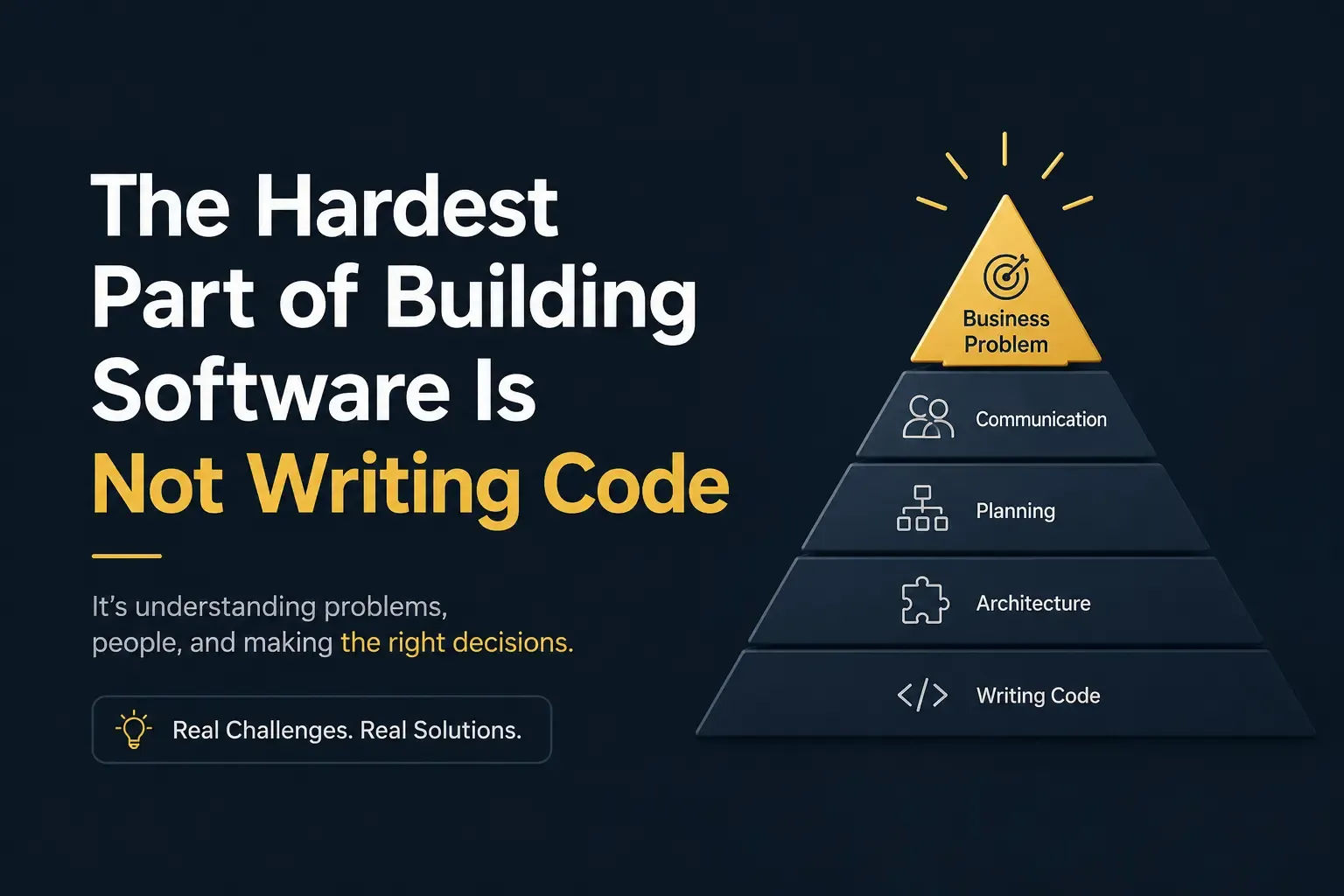
The Hardest Part of Building Software Is Not Writing Code
Most people believe software developers spend their time writing code.
Save this post for later or send it to someone working on SEO, frontend, or product UX.
Introduction#
Most people believe software developers spend their time writing code.
That is only a small part of the job.
Experienced developers know that typing code is often the easiest stage of building software. Modern frameworks, AI assistants, documentation, and open-source libraries have made implementation significantly faster than it was a few years ago.
The difficult part begins long before the first line of code is written.
Successful software depends on understanding people, solving business problems, making trade-offs, planning architecture, communicating clearly, handling changing requirements, and delivering something that users actually want to use.
Many software projects fail even when the code is technically excellent because the real problem was never the code itself.
If you have ever wondered why some software succeeds while other projects become expensive failures, the answer usually lies outside programming.
Table of Contents#
Why Writing Code Is the Easy Part
Understanding the Real Business Problem
Requirements Change Constantly
Communication Builds Better Software
Good Architecture Prevents Future Problems
Every Feature Has a Cost
User Experience Matters More Than Clever Code
Testing Is More Than Finding Bugs
Software Is Never Truly Finished
What Businesses Should Look For in a Developer
Lessons Every Developer Learns Eventually
Final Thoughts
Why Writing Code Is the Easy Part#
Modern development has changed dramatically.
Developers have access to:
AI coding assistants
Mature frameworks
Millions of open-source packages
Detailed documentation
Community support
Automated testing tools
Writing a feature is often straightforward once everyone agrees on what should be built.
The real challenge is figuring out what should be built in the first place.
Many developers can implement a login page.
Far fewer can identify whether the business actually needs email login, OTP authentication, social login, role management, or something completely different.
The quality of the decision matters far more than the speed of implementation.
Understanding the Real Business Problem#
Clients usually describe solutions instead of problems.
For example, a client might say:
"We need a dashboard."
But after asking questions, the real need may be:
Reduce customer support calls
Increase sales conversions
Track employee productivity
Automate manual work
Improve reporting
The dashboard is only one possible solution.
Great software developers don't simply build requested features.
They understand the business objective first.
That is where successful software begins.
Requirements Change Constantly#
One of the biggest misconceptions about software development is believing requirements stay fixed.
In reality:
markets change
competitors launch new features
customers give feedback
regulations evolve
businesses discover new opportunities
Software must adapt.
Developers who build flexible systems save businesses significant time and money later.
Rigid systems become expensive to maintain.
Good architecture expects change instead of resisting it.
Communication Builds Better Software#
Poor communication is responsible for countless failed projects.
A technically perfect application can still fail if:
the client expected something different
users don't understand the interface
important workflows were ignored
deadlines were unrealistic
assumptions were never discussed
Clear communication prevents expensive mistakes before development even begins.
This is why experienced developers spend considerable time asking questions instead of immediately opening their code editor.
Good Architecture Prevents Future Problems#
Architecture is similar to designing the foundation of a building.
Most users never see it.
Yet everything depends on it.
Good software architecture makes applications:
easier to maintain
easier to scale
faster to extend
more secure
easier to test
Poor architecture often appears acceptable during the first few weeks.
Its problems become visible months later when every new feature requires changing dozens of files.
The best architecture often feels invisible because everything simply works.
Every Feature Has a Cost#
Businesses often focus on adding features.
Experienced developers also think about the cost of maintaining those features.
Every new feature introduces:
additional testing
documentation
future maintenance
possible bugs
security considerations
user interface complexity
Sometimes the best engineering decision is saying no.
Removing unnecessary complexity usually creates better software.
Simple products are easier to maintain and easier for customers to use.
User Experience Matters More Than Clever Code#
Users never read source code.
They experience the product.
An application with beautiful architecture but confusing navigation will frustrate customers.
On the other hand, software with ordinary implementation but an excellent user experience often becomes highly successful.
Good software feels intuitive.
Users should achieve their goal without needing instructions.
That experience is the result of thoughtful design, not complicated algorithms.
Testing Is More Than Finding Bugs#
Testing is frequently misunderstood.
Its purpose is not simply identifying mistakes.
Testing creates confidence.
It answers questions such as:
Does the payment system still work?
Will this update break existing features?
Can we release safely?
Are edge cases handled?
Reliable testing reduces business risk.
The earlier problems are discovered, the less expensive they become to fix.
Software Is Never Truly Finished#
Launching a product is only the beginning.
Real software continues evolving through:
customer feedback
performance improvements
security updates
new integrations
feature enhancements
infrastructure upgrades
Successful software products improve continuously instead of remaining static.
The companies that invest in ongoing improvement usually outperform those treating software as a one-time expense.
What Businesses Should Look For in a Developer#
When hiring a developer, technical ability is only one factor.
Businesses benefit most from developers who can:
understand business goals
communicate clearly
suggest better solutions
identify future risks
write maintainable code
prioritize long-term value over shortcuts
The best developers are problem solvers first and programmers second.
Lessons Every Developer Learns Eventually#
After building multiple real-world projects, most developers discover the same truth.
Writing code is only one skill among many.
Professional software development also requires:
patience
empathy
planning
communication
architecture
continuous learning
business understanding
Technology changes every year.
The ability to solve problems remains valuable regardless of the programming language or framework.
Final Thoughts#
The hardest part of building software is not writing code.
It is understanding people.
It is translating business goals into practical solutions.
It is making thoughtful technical decisions that continue delivering value months and years after launch.
Code is simply the tool.
Problem-solving is the profession.
The best software is rarely remembered because of clever algorithms.
It is remembered because it quietly solves real problems, saves time, reduces complexity, and helps people accomplish their goals.
When software achieves those outcomes, the code has already done its job.
Key Takeaways#
Writing code is only one stage of software development.
Understanding business problems creates better products.
Communication prevents expensive project failures.
Good architecture makes future development easier.
Simple software often delivers the greatest value.
Successful products evolve continuously after launch.
The best developers solve problems before writing code.
Frequently Asked Questions#
Is writing code the hardest part of software development?#
No. Many experienced developers believe understanding business requirements, communication, architecture, and decision-making are more challenging than implementation itself.
Why do software projects fail?#
Projects commonly fail because of unclear requirements, poor communication, unrealistic expectations, changing priorities, and weak planning rather than poor programming.
What makes a software developer valuable?#
A valuable developer understands both technology and business needs, communicates effectively, builds maintainable systems, and focuses on solving real problems instead of simply delivering features.
Why is understanding the business important in software development?#
Software exists to solve business problems. Without understanding the objective, even technically perfect code may deliver little real value.