CarryZo CRM
role-based logistics operations CRM that brings trips, customers, fleet, and revenue into one command center.
CarryZo CRM is a Next.js logistics operations platform built to manage trips, customers, drivers, vehicles, transporters, analytics, notifications, and exports from a single dashboard.
role-based logistics operations CRM that brings trips, customers, fleet, and revenue into one command center.
Operations data was spread across customers, trips, vehicles, drivers, and transporters, making day-to-day coordination harder.
Different internal roles needed different levels of visibility, especially around commercial metrics like revenue.
Logistics teams needed faster access to follow-up actions such as inactive customers, declining accounts, pending payments, and idle vehicles.
Exporting operational records for reporting and sharing had to be simple for non-technical users.
Trip execution needed stronger delivery proof, not just status updates.
Built a centralized CRM with dedicated modules for trips, customers, vehicles, drivers, and transporters.
Added role-based dashboards so admins can access revenue analytics while managers stay focused on operational KPIs.
Created analytics endpoints with short-term caching to improve dashboard responsiveness.
Introduced alerting for inactive customers, declining demand, pending payments, and idle assets.
Added CSV and PDF export tooling for customers, trips, vehicles, drivers, and transporters.
Implemented proof-of-delivery capture with receiver details, photo upload, timestamp, and GPS location.
Deliverables: Operations dashboard, Trip management system, Customer CRM, Driver management, Vehicle management, Transporter management, Role-based authentication, Analytics and reporting, Notification system, CSV and PDF exports, Proof-of-delivery workflow.
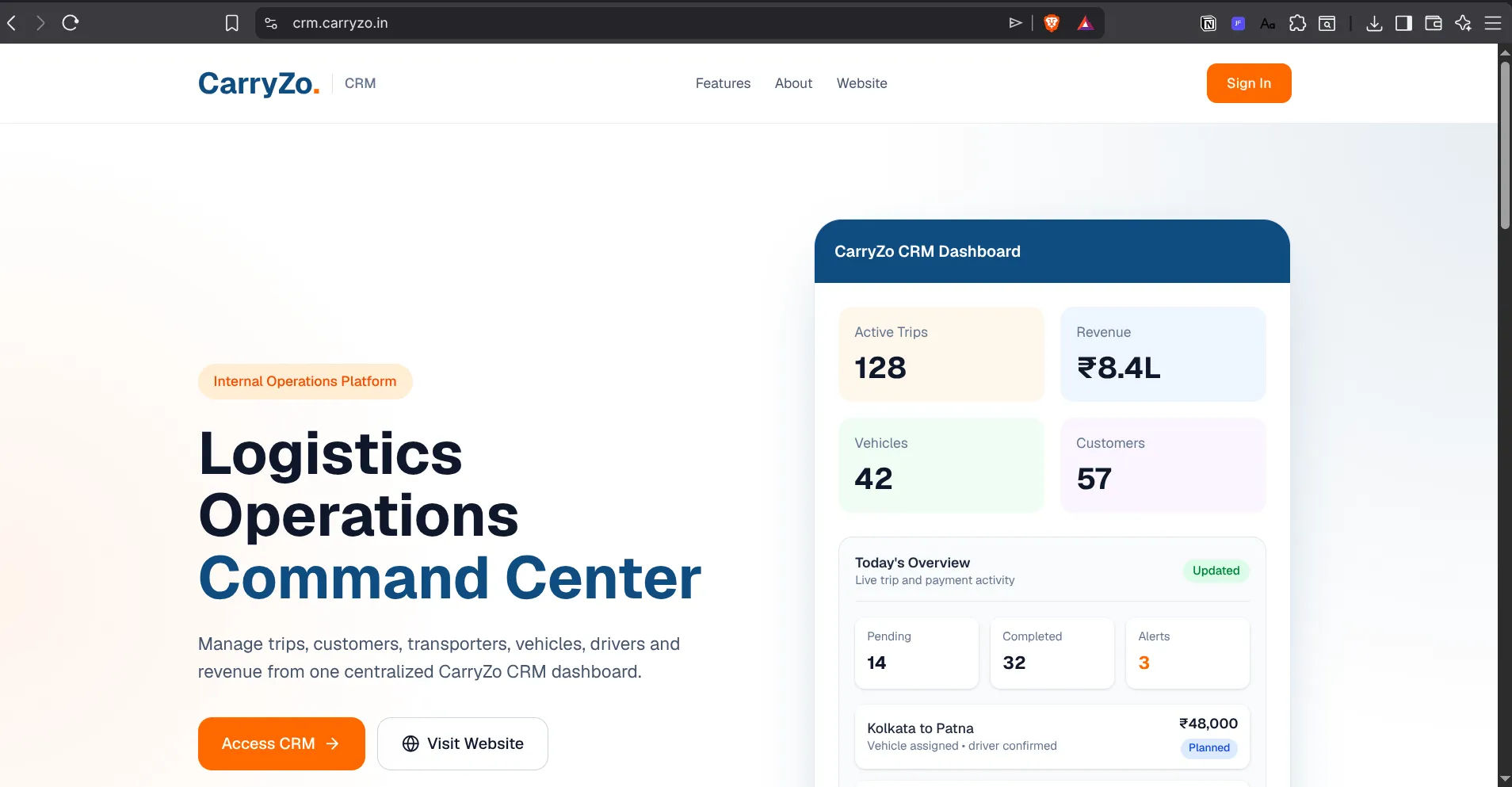
CarryZo CRM is a Next.js logistics operations platform built to manage trips, customers, drivers, vehicles, transporters, analytics, notifications, and exports from a single dashboard.CarryZo Logistics (Vikash Patel) field note
Reduced operational switching by giving teams one place to manage logistics workflows.
CarryZo CRM is a full-stack logistics operations platform that centralizes trip management, customer relationships, fleet coordination, revenue tracking, alerts, exports, and proof-of-delivery into one role-based dashboard.
Smarter logistics operations for a growing delivery business#
CarryZo CRM was built as an internal operations platform for a logistics business that needed more control over day-to-day movement. Instead of managing customers, trips, vehicles, drivers, and transporters across disconnected processes, the product brings everything into one unified dashboard built around the realities of logistics execution.
The system gives teams a single place to create and manage trips, assign vehicles and drivers, maintain customer records, track transporter relationships, and monitor payment status. For operations-heavy businesses, that kind of consolidation matters because every delay, missing detail, or follow-up gap creates friction downstream.
Designing for both operations and leadership#
One of the strongest product decisions in CarryZo CRM is its role-based experience. The platform separates what different users need to see instead of forcing everyone into the same dashboard.
Admins get an executive view with revenue metrics, trip performance, customer health, top accounts, and commercial reporting. Managers get a more operational view focused on workload, customer movement, inactive accounts, declining activity, and attention items. That separation keeps sensitive financial data protected while making the interface more useful for each role.
Turning data into action#
Beyond CRUD screens, the product is designed to surface action. The analytics layer highlights inactive customers, declining customers, revenue trends, trip volume, and payment-state breakdowns. A notification system adds another operational layer by flagging pending payments, idle vehicles, and accounts that need reactivation.
This makes the CRM more than a record-keeping tool. It becomes a lightweight decision-support system for the team running logistics on the ground.
Workflow features built for real operations#
The trip workflow is especially practical. Teams can create trips, assign internal vehicles and drivers, or handle external vehicle and driver details when needed. That flexibility reflects how logistics businesses actually work, where owned and partner-operated resources often coexist.
CarryZo CRM also includes proof-of-delivery capture, allowing teams to save receiver details, delivery notes, a photo, delivery timestamp, and GPS coordinates. That feature adds accountability at the end of the trip lifecycle and helps connect planning with delivery confirmation.
Reporting without extra admin work#
The platform includes built-in CSV and PDF exports across major entities like customers, trips, vehicles, drivers, and transporters. This helps teams move from operations to reporting without needing custom queries or manual spreadsheet cleanup every time someone asks for a summary.
Global search and structured dashboards further reduce friction by making it easier to find records quickly and spot issues before they grow.
Technical approach#
CarryZo CRM is built with Next.js 16, React 19, TypeScript, Tailwind CSS, MongoDB, and Mongoose. The frontend uses a modern component-driven architecture with reusable UI primitives, while the backend exposes API routes for analytics, exports, authentication, notifications, and operational data management.
The codebase also shows thoughtful attention to performance and maintainability through indexed schemas, parallelized data fetching, short-lived API caching for analytics and notifications, and a clean separation between domain models, queries, UI components, and auth utilities.
Outcome#
CarryZo CRM demonstrates how a focused internal tool can create real leverage for a logistics business. By combining operations management, customer intelligence, analytics, alerts, and delivery verification into one product, it gives the team a clearer operating picture and a stronger foundation for scale.
For a case study, the most important takeaway is that this project is not just a dashboard UI. It is a workflow platform built around the full rhythm of logistics operations, from customer acquisition and trip planning to reporting and proof of delivery.